Looking for the best resource management board games to test your strategy skills? Whether you enjoy building efficient engines, optimizing production chains, or outmaneuvering opponents through clever economic decisions, this genre offers some of the deepest and most rewarding gameplay experiences in tabletop gaming.
In this guide, you’ll find the top resource management board games for every type of player—from beginner-friendly classics to complex, strategy-heavy masterpieces. Whether you’re playing solo, with a partner, or in a competitive group, there’s something here for you.
We’ve focused on games that deliver meaningful decisions, strong replayability, and satisfying progression, so you can spend less time researching and more time playing.
Best Resource Management Board Games – Quick Picks
🏆 Best Overall: Brass: Birmingham – Deep, rewarding, and endlessly replayable
👶 Best for Beginners: Catan – Easy to learn, still highly strategic
⚙️ Best Engine Builder: Terraforming Mars – Incredible long-term planning
🧠 Best Heavy Strategy Game: Gaia Project – Complex, zero-luck optimization
🌿 Most Beautiful Game: Everdell – Gorgeous design with solid mechanics
Quickly compare the best resource management board games by complexity, playtime, and play style:
| Game | Players | Playtime | Complexity | Best For | Core Strength |
|---|---|---|---|---|---|
| Brass: Birmingham | 2–4 | ~120 min | ⭐⭐⭐⭐☆ | Advanced players | Deep economic strategy |
| Gaia Project | 1–4 | ~120 min | ⭐⭐⭐⭐⭐ | Hardcore strategists | Zero-luck optimization |
| Terraforming Mars | 1–5 | ~120 min | ⭐⭐⭐⭐☆ | Engine builders | Card-driven economy |
| A Feast for Odin | 1–4 | ~120–180 min | ⭐⭐⭐⭐⭐ | Sandbox lovers | Massive worker placement |
| Concordia | 2–5 | ~90 min | ⭐⭐⭐☆☆ | Balanced strategy | Card-driven resource system |
| Clans of Caledonia | 1–4 | ~90 min | ⭐⭐⭐⭐☆ | Euro fans | Market-driven economy |
| Scythe | 1–5 | ~115 min | ⭐⭐⭐☆☆ | Hybrid players | Engine + area control |
| Everdell | 1–4 | ~60–90 min | ⭐⭐⭐☆☆ | Casual + strategy mix | Tableau building |
| Puerto Rico | 2–5 | ~90–120 min | ⭐⭐⭐⭐☆ | Competitive groups | Role selection |
| Catan | 3–4 | ~60–90 min | ⭐⭐☆☆☆ | Beginners | Trading & accessibility |
If you click on an affiliate link, it will take you to the Amazon store. If you then buy something, I will earn a commission – I am a member of the Amazon Associates program, as well as others.
Last updated: April 2026
10. Settlers of Catan
👉 Best for: Beginners and casual players looking for a fun, social strategy game.
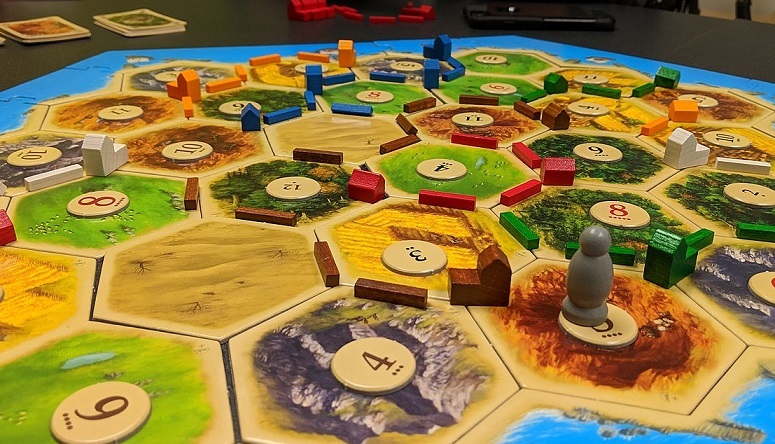
Catan is one of the most accessible resource management board games and a perfect introduction to the genre.
Players collect resources through dice rolls and trade with others to build settlements and expand their territory. The interactive trading system keeps the game engaging and unpredictable.
It’s easy to learn but still offers strategic decisions.
9. Puerto Rico
👉 Best for: Players who enjoy competitive gameplay with minimal luck.
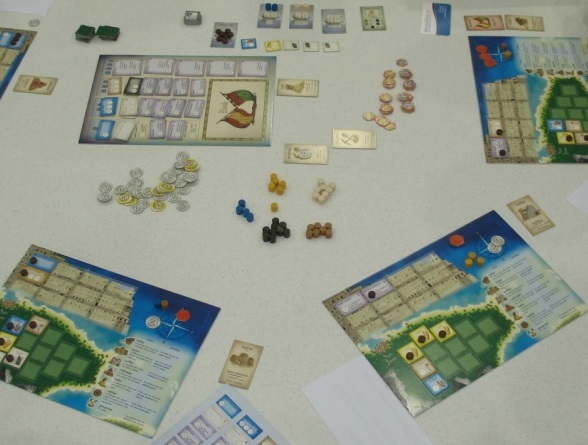
Puerto Rico is a classic Eurogame that emphasizes efficiency, timing, and strategic decision-making.
Players select roles that determine actions for everyone, creating a system where every choice affects the entire table. Managing resources, buildings, and workers efficiently is key to success. Game’s low randomness makes it a pure strategy experience.
Puerto Rico was the game that first introduced role-selection mechanics. For example, if you take the Builder role this turn, all players can construct a building, but you get to do it at a discount. Unused roles accumulate cash bonuses on them, encouraging players to use all of them eventually.
8. Everdell
👉 Best for: Players who want a visually appealing game with solid strategy.
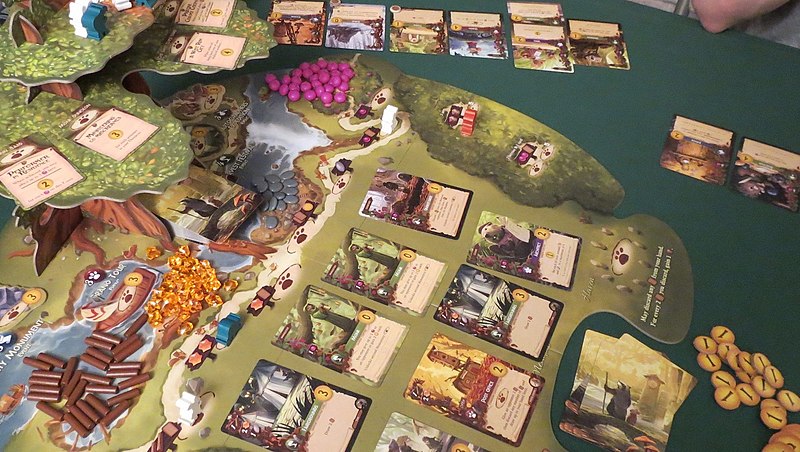
The charming valley of Everdell is a lovely piece of the forest. In the shades of mighty trees, a civilization of forest critters is looking to expand into new territories and establish new cities. Will your part of the forest be the most lustrous?
Everdell is a worker-placement game with a large emphasis on building a tableau of cards in front of you. Workers perform basic actions, such as gathering resources and drawing cards, while your tableau will provide more advanced actions, combos, and point-scoring abilities.
There are cute resources to manage (twigs, resin, pebbles, berries) and the whole game is a joy to witness on the table, such is its appearance.
7. Scythe
👉 Best for: Players who want a mix of strategy, engine building, and light conflict.
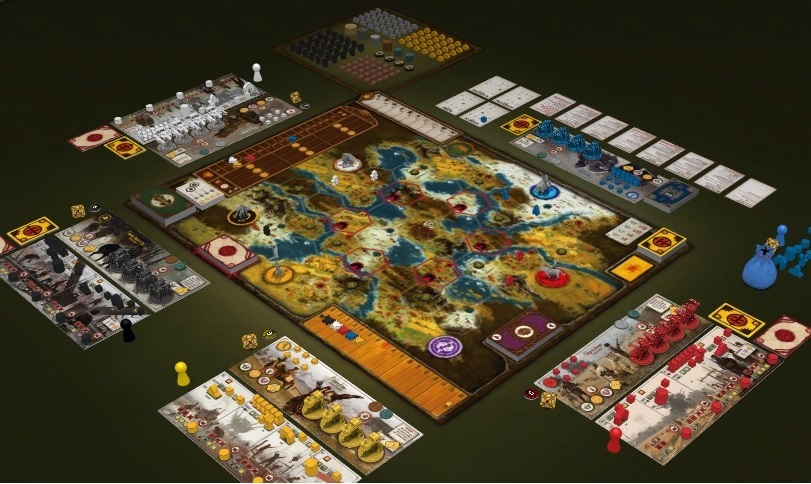
Europe, just after the Great War. The diesel-punk mechs are the main weapon to keep the population and other nations in check. Can you build a solid economy in this forsaken world?
Scythe is a very tight engine-building game. You start with only a few workers, and by cultivating the land for iron, food, oil, and wood your workforce and economy will slowly grow, allowing you to spread out more, build mechs, and various structures. All of which will help earn those valuable victory points.
Because you can’t perform the same action twice in a row, you’ve got to carefully plan ahead to make sure you’ve got the right resources at the right time. But watch out, because other players can steal them from you in battle! But, while it includes combat, it’s primarily about optimizing your economy.
6. Clans of Caledonia
👉 Best for: Players who enjoy market-driven strategy and economic gameplay.
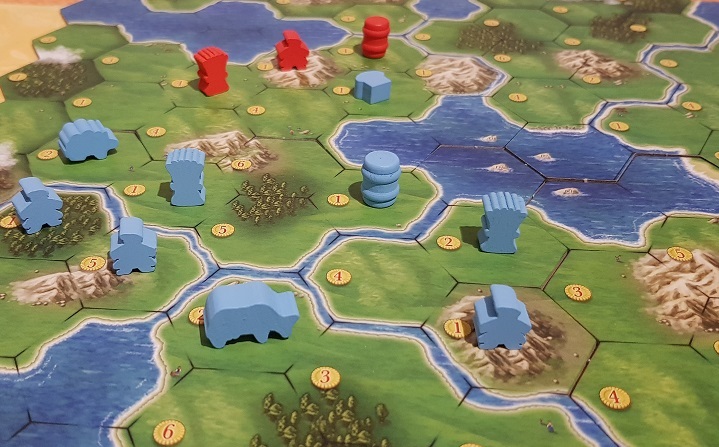
Clans of Caledonia blends classic resource management with a dynamic market system that reacts to player decisions.
Set in 19th-century Scotland, players produce and trade goods like milk, cheese, and whisky. Prices fluctuate based on supply and demand, adding an extra layer of strategy.
Eight clans are available, and each comes with a special ability, creating asymmetry and diversity, yet offering balanced gameplay. In each round, you’ll perform actions such as constructing buildings, trading goods on the market, acquiring and fulfilling export contracts, or upgrading your abilities.
Clans of Caledonia full review
You can perform as many actions as you can afford, and here’s where the resource management aspect comes into place. Construct the right buildings to produce the right goods (wheat, milk, cheese, whiskey, cows, and sheep), trade what you can’t produce so that you can fulfill the most lucrative export contracts, and score the most points.
5. Concordia
👉 Best for: Players who want a balanced, low-randomness strategy game with smooth gameplay.
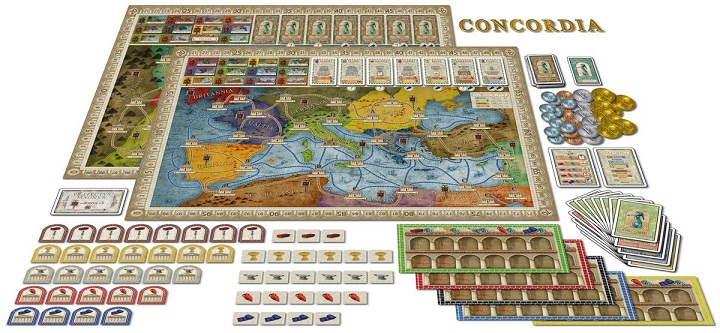
The Mediterranean has always been the breadbasket of trade. In Roman times, the surrounding area was as prosperous as ever. Business flourished and everyone wanted a piece of the pie. Including the players of this game, each playing a Roman dynasty, ready to get rich.
5 Reasons Why You Should Play Concordia
You start with a couple of colonists in Rome. As you spread out, you’ll be able to build new trading posts in cities, which will yield you more resources to build more posts. Brick, grain, tools, wine, and cloth. You can buy, sell, produce, and spend them as you please.
The elegant card-driven system keeps gameplay smooth while offering meaningful decisions every turn. You can add new cards to your deck. These also help with the endgame scoring – you need to align the suit of your cards to your actions on the board for maximum points.
Cocnrdia is a streamlined yet deeply strategic resource management game focused on efficiency and planning: easy to learn but difficult to master.
4. A Feast for Odin
👉 Best for: Players who enjoy open-ended gameplay with lots of strategic freedom.
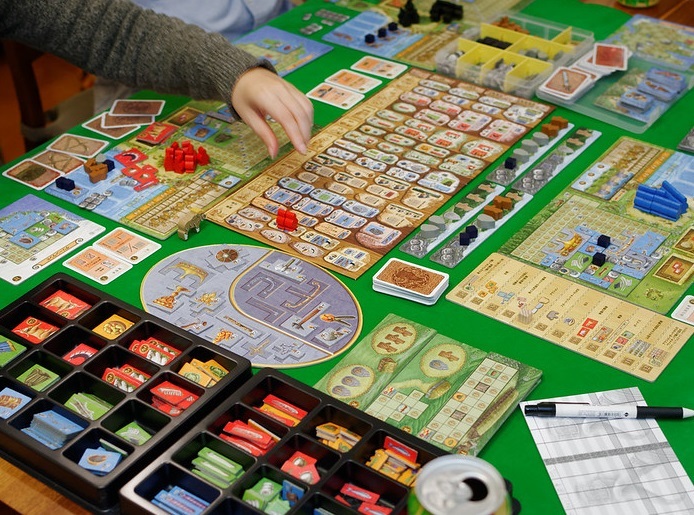
To be frank, I could have put any of Uwe Rosenberg’s farming games here: Agricola, Caverna, At the Gates of Lo Yang, and The Fields of Arle, to name a few. But I’ve decided to go with his Viking-themed title from 2016. Each player controls a Viking tribe that farms, hunts, explores, and raids. Your goal is to cover your home board with loot, completing a spatial puzzle.
We could best sum up the game as a worker-placement sandbox. There are 61 slots that allow you to build houses and ships, hunt, manage livestock, produce and manage resources, sail, and occupy new lands.
You can take your tribe in any direction, as they are all valid choices. To complete your objectives, you’ll have to carefully manage countless resources – going into such details as having pregnant animals.
If you want to be a Viking – now is your chance!
3. Terraforming Mars
👉 Best for: Players who enjoy building powerful engines and optimizing strategies over time.
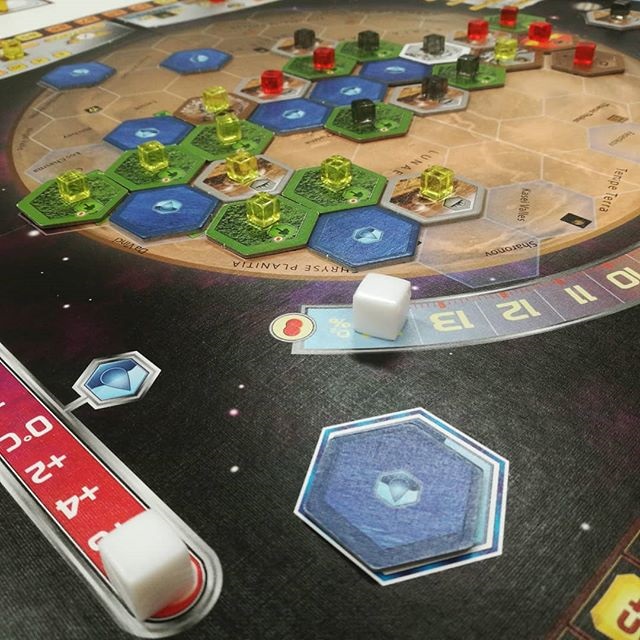
A couple of centuries into the future and humanity is finally settling on Mars. But to make it fully habitable, we need to fill the oceans, plant forests, and erect cities.
Players control corporations working to make Mars habitable, managing resources like money, steel, titanium, plants, and energy. By playing cards that improve production and create synergies, you gradually build a powerful economic engine.
Terraforming Mars is focused on card drafting. There are over 200 cards that represent sci-fi thematic projects that players can complete. Build a space elevator, capture an asteroid, or complete one of the less exciting projects: Fusion Power, Biomass Combustors, or Solar Power.
But you won’t be able to complete many projects if your economic foundations aren’t solid. You need to build an engine that will produce money, energy, heat, titanium, and steel. Manage energy into heat, use greenery to build forests, and add oxygen to the atmosphere to make it breathable.
In the tight economic system that Terraforming Mars provides, only the true strategists will populate the surface, make it habitable, and build exciting projects.
2. Gaia Project
👉 Best for: Advanced players who enjoy deep, highly strategic gameplay with no reliance on luck.
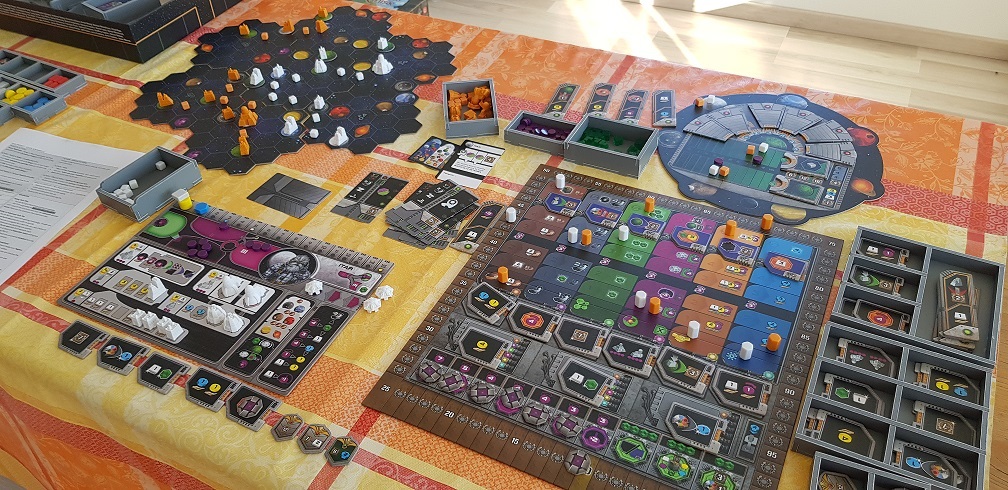
Terra Mystica uses one of the tightest and more strategic economic systems in board gaming. It’s rightfully considered a classic. Gaia Project is its direct successor, further improving the superior system. It’s set in space, where 14 factions with various special abilities compete in colonizing the planets to their liking.
But don’t mistake this for a political mega-game such as Twilight Imperium. No, this is entirely peaceful and mechanical. Use ore and money to adapt planets, and build mines, trading posts, laboratories, and institutes.
Laboratories will produce science, which can be used to research new technologies. This boost your economy and helps with the endgame score. Then there’s power, a fluctuating resource that powers up in stages and can be spent to gain various benefits. And quantum intelligence cubes, a wild resource, useful for traversing vast distances in space.
You need to time your expansions according to round goals (to score maximum points), which (together with scarce resources) means Gaia Project presents a superb economic puzzle and an excellent challenge for heavy gamers.
Check out Age of Innovation, a further development of the TM system
1. Brass: Birmingham
👉 Best for: Experienced players who want deep strategy, strong interaction, and long-term planning.
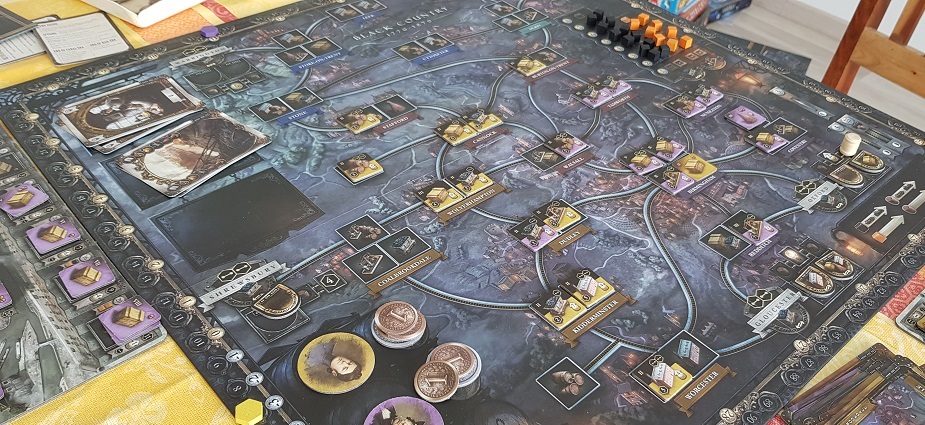
Brass: Birmingham is widely regarded as one of the best resource management board games ever made, offering deep economic strategy and meaningful player interaction.
The industrial revolution is at its height and one of its bustling centers is in Birmingham. You will play as an industrial magnate of the era. Build canals, rails, and various industries in Birmingham and surrounding cities to become the wealthiest industrialist.
While normally in board gaming the resources are spent from your board or a personal bank, Brass uses a different approach. There are only three resources: coal, iron, and beer. When they are produced from constructed buildings, they stay right there, on the board, for everyone to spend.
This adds another layer of strategy. Not only do you need resources when performing actions, but you also need to logistically transport them to the place of need. You need to plan your rails carefully, hand in hand with your needs. You can even be a bit cheeky and use your opponent’s rails.
While this may sound restrictive, Brass leaves you plenty of freedom and never feels tight. There’s always something to do, and you feel like you’re progressing and having fun. Of course, to win, you need to crunch all the possibilities, but even a casual player will have a lot of fun in Brass: Birmingham.
FAQ
Who Should Play Resource Management Games?
Advanced players: Dive into Brass: Birmingham or Gaia Project
Beginners: Start with Catan or Everdell
Intermediate players: Try Terraforming Mars or Puerto Rico
What is a resource management board game?
A resource management board game is a type of strategy game where players collect, produce, and spend resources efficiently to achieve victory. These resources can include money, materials, energy, or workers, and success depends on optimizing how they are used over time.
What is the best resource management board game for beginners?
Catan is widely considered the best starting point. It has simple rules, interactive gameplay, and introduces core concepts like trading and resource production without overwhelming complexity.
What is the most complex resource management board game?
Gaia Project is one of the most complex and strategic resource management games available. It features deep planning, no randomness, and a heavy focus on long-term optimization.
Are resource management board games good for solo play?
Yes—many modern resource management games include excellent solo modes. Terraforming Mars, Gaia Project, and Scythe all offer strong solo experiences that focus on efficiency and optimization.
What’s the difference between resource management and engine-building games?
Resource management focuses on efficiently using limited materials, while engine-building games emphasize creating systems that generate increasing value over time. Many games—like Terraforming Mars—combine both mechanics.
Which resource management board game has the most replayability?
Games with high variability—like Terraforming Mars (due to its large card pool) offer excellent replayability because each session can give you vastly different starting points.
I absolutely love Settlers of Catan! It’s a classic board game that’s easy to learn but offers endless strategic possibilities. I love how the board is different every time you play, so every game feels fresh and exciting. Plus, negotiating and trading with other players adds a whole new level of social interaction to the game. If you haven’t played Settlers of Catan yet, I highly recommend giving it a try!
I’ve heard about Catan, yes. There are several articles about in on this site already. 🙂